GadgetGlowBytes: Your go-to hub for in-depth gadget reviews, breaking tech news, and expert tips to supercharge your everyday tech experience.
A 65W Charger, a $1 Cable and a 20,000mAh Power Bank: Three Baseus Charging Basics, and Where the Savings Stop
Get link
Facebook
X
Pinterest
Email
Other Apps
-
AliExpress Analysis
A 65W Charger, a $1 Cable and a 20,000mAh Power Bank: Three Baseus Charging Basics, and Where the Savings Stop
What the independent tests say, what they do not cover, and which of the three we would actually buy
GB
GadgetGlow Bytes Editorial
Published October 14, 2026 · 9 min read · How we work
Affiliate disclosure: this article contains affiliate links. If you buy through them we may earn a small commission at no extra cost to you. That does not change what we recommend — we have not physically tested these products, and everything below is based on published specifications, independent coverage and seller data, all sourced at the end. Prices were checked on October 14, 2026 and change frequently.
Chargers, cables and power banks are the least glamorous things you will buy online, which is why they deserve a careful look: you use them daily and plug them into the mains or a device worth hundreds of dollars. This post covers three Baseus products from the brand's official AliExpress storefront: a 65W GaN wall charger, a 100W USB-C cable, and a 20,000mAh power bank.
We chose one established brand on purpose, so the "is this even a real company?" question is mostly settled and we can ask what matters: does the spec sheet survive independent testing, and when is the cheaper option the right call? It is for anyone topping up phones and a laptop who wants to know how much risk the savings carry.
One limitation up front: the independent tests we found cover earlier or neighbouring Baseus models, not these exact listings. We name the gap each time instead of pretending it is not there.
The three at a glance
Product
AliExpress price
Branded alternative
Shipping
Warranty
Baseus 65W GaN charger
$19.45 (EU plug listing)
Anker chargers; site lists the range at $15–$181
Oct 21–26 quoted
Store return window shown: 90 days
Baseus 100W USB-C cable, 1 m
$1.09 new-shopper price
Anker 100W 6 ft, about $9 for two
Oct 19–24 quoted
Store return window shown: 90 days; Anker lists a lifetime warranty
Baseus 100W 20,000mAh power bank
$62.83
Anker 20,000mAh 87W, ¥9,990 in Japan
Oct 24–31 quoted
Return policy listed; window not recorded. Anker: 18 months, up to 24 if registered
Compiled by GadgetGlow Bytes. Prices verified October 14, 2026 from a logged-out browser session; shipping windows are the dates the listings quoted that day.
1. Baseus 65W GaN Charger (GaN5, USB-C and USB-A)
Seller image, AliExpress
~$19.45 · checked Oct 14, 2026
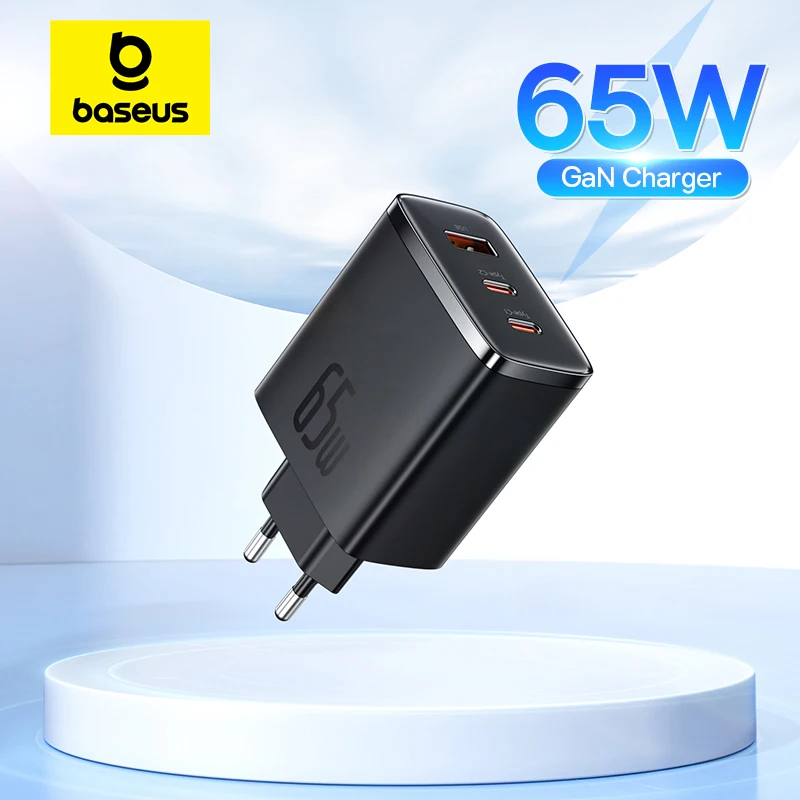
This is a compact wall charger that uses gallium nitride switching parts to deliver up to 65W from its USB-C port, enough to run a thin laptop and charge a phone off the same brick. The listing mentions support for USB PD, Quick Charge and several phone-maker fast-charge protocols, which in practice means most phones and tablets will negotiate their fastest speed.
The price needs context. The $19.45 sits next to a struck-through "$58.98" that we treat as marketing, and it is a new-shopper deal. The plug options we saw were all EU-style, so a US or UK buyer would need an adapter or a different variant.
Who it's for — and who should skip it
Good for someone whose wall sockets match the listed plug and who wants one brick for a phone and a light laptop. Skip it if the plug does not match your country.
The risks
Shipping: the listing quoted October 21–26 and said 80.9% of orders arrive within 12 days. Slower tails are normal on this platform.
Warranty reality: the store shows a 90-day return window. That is a return right, not a multi-year warranty.
Quality and counterfeit risk: unbranded and fake chargers are the category where cutting corners is most dangerous. In a widely cited 2014 teardown of a counterfeit iPad charger, Ken Shirriff found less insulation around the parts and a 5W unit sold as 10W.
Evidence gap: the only teardown we found, by ChargerLab, covers an older Baseus 65W model from 2019 with a fuse, isolation spacing and branded GaN and controller chips. It does not cover this GaN5 unit.
The alternative
Anker's site lists chargers from $15 to $181; we could not confirm a price for an exactly equivalent 65W model. Paying for a locally stocked brand is the right call when the charger lives in a child's room or behind a desk: local plug, local return, enforceable warranty.
What we don't know: we have not handled this charger, so its real efficiency and heat under load are unknown.
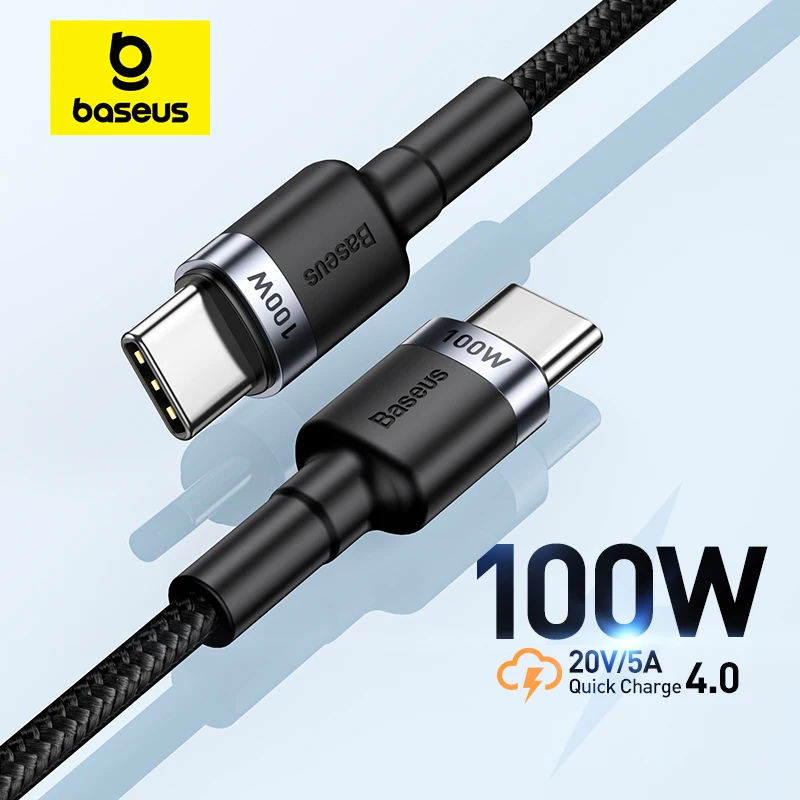
A braided USB-C to USB-C cable rated for 100W at 5A, offered in 1 m and 2 m lengths. Without a proper identification chip (an e-marker), a cable is limited to 3A, or 60W.
Of the three products, this is the one with the best independent evidence. A German review site, Techtest, checked cheap 100W cables in 2020 and found Baseus cables correctly identified as 100W/5A, while another low-cost brand's cables, packaged as 100W, only identified as 60W on its test gear. The $1.09 figure is a new-account price against a "$11.38" struck-through reference, so the price you pay may differ.
Who it's for — and who should skip it
Anyone who needs spare charging cables for laptops and phones. Skip it for fast external SSDs or video: the review we found did not test data speed.
The risks
Shipping: the listing quoted October 19–24.
Warranty reality: a 90-day return window is shown; in practice the warranty is replacing the cable.
Quality variance: the review we cite tested earlier Baseus cables, not this variant, and the same listing also offers 60W versions, so pick the 100W one.
Counterfeit risk: a wrongly rated cable can overheat. Buy from the official store only.
The alternative
Gizmodo reported on September 16, 2026 that Anker's 100W 6 ft cable was about $9 for a two-pack on Amazon, with a lifetime warranty. That is under $5 a cable. The AliExpress cable wins only on price, and the gap is a few dollars.
What we don't know: we have not handled this cable, so durability and e-marker behaviour in your unit are unknown.
A 20,000mAh battery with a combined output of up to 100W across several ports, enough in principle to charge a laptop as well as phones. It sits on the official Baseus store with 4.9 stars across about 1,500 reviews.
Read the capacity number carefully. Two independent tests of other Baseus 20,000mAh banks give a useful guide: Techtest measured between 17,398 and 18,787 mAh from a 20,000mAh model, about 87 to 94 percent of the claim, and an OzBargain analysis put a 65W Baseus at roughly 87 percent efficiency, delivering 64.38 Wh from a rated 74 Wh. Neither tested this 100W unit. The struck-through "$133.32" on the listing is a reference price we would ignore.
Who it's for — and who should skip it
A traveller who wants one battery for a phone, earbuds and an occasional laptop top-up. Skip it if you only charge a phone: the 20W model Techtest reviewed at about €30 does that for far less.
The risks
Shipping: the listing quoted October 24–31, the slowest of the three.
Warranty reality: a return policy is listed but we did not record its window.
Counterfeit and inflated-capacity risk: when we searched the same marketplace for 20,000mAh power banks, the results were crowded with listings claiming 500,000mAh, which is not physically plausible at that size. Buying from the official store matters here more than for the other two items.
Evidence gap: no independent test of this 100W model turned up in our searches.
The alternative
Anker's 20,000mAh power bank with 87W output lists at ¥9,990 on its Japanese store (checked October 14, 2026), with an 18-month warranty and up to 24 months if you register. We have not converted that to dollars. Paying more for a brand with a stated multi-month warranty is the right call for a battery you will carry in a bag and charge overnight.
What we don't know: we have not handled this power bank, so real capacity, heat and protection behaviour are unknown.
Norton's consumer guide describes typical delivery as 5 to 45 days depending on item and shipping method, with tracking that is not always current. Treat quoted dates as estimates; do not order a replacement charger the day before you need it.
Buyer protection is the real safety net. According to the same guide, refunds are available if an order does not arrive, arrives damaged, or does not match its description, as long as the listing shows a buyer protection label, and you have 15 days after confirming receipt to file a claim. Paying by credit card adds a chargeback option. Screenshot the listing and variant before you buy.
Read the seller, not only the product. All three items here are on the official Baseus storefront, which is the single most useful filter for the counterfeit problem. We excluded one power bank from an unrelated store whose images carried a WhatsApp contact watermark. If an item arrives broken, photograph it with the packaging and open a dispute within the window.
Our Read
Buy the cable. It is the only one of the three where the independent evidence is directly relevant, the downside of a bad unit is small, and the saving over a known brand is real if modest. Pick the 100W variant of the listing, buy from the official store, and expect to pay a few dollars rather than the headline price. The charger is a conditional yes: if the plug type matches your wall and you check the safety marks on arrival, the price is attractive, but the teardown we found describes an older model, and a charger is the product where we would rather pay for a local warranty if the budget allows. The power bank is the one we would skip. It costs the most, ships the slowest, has no independent test of this model, and sits in a category where inflated listings are common. For a phone-only user, a cheaper 20W bank or Anker's lower-priced models do the job.
What we still don't know: we have not handled any of these units. Only hands-on use would show real charging speed under load, surface temperatures, how the cable and the power bank age, and how the seller handles a claim.
Top 3 Best-Selling Mini PCs on AliExpress in 2025 – Which One Is Worth It? Hey everyone! In today’s post, we’re diving into the top 3 best-selling mini PCs on AliExpress up until June 2025. We'll take a close look at their advantages, disadvantages, performance, and even some of the funniest (and most helpful) customer reviews. If you’re looking for a compact, affordable, and surprisingly powerful mini computer, this post is for you. Let’s start with the first one on our list: the famous GMKtec G3 . According to AliExpress, this model has already sold over 10,000 units — and it’s not hard to see why. It comes with an Intel Alder Lake N100 processor , reaching up to 3.4 GHz, and is available with 8 GB or 16 GB of DDR4 RAM , and a 256 GB or 512 GB M.2 PCIe SSD , depending on the version you choose. Aliexpress Link: https://s.click.aliexpress.com/e/_oC43Wwa One standout feature is its two HDMI 2.0 ports , allowing you to connect dual 4K moni...
Best tablet controller for iPad Pro 13-inch, the Razer Kishi V3 Pro XL snaps onto larger tablets to deliver console-level comfort and precision for cloud gaming and native apps. Design & Compatibility Built from anodized aluminum and reinforced polymer, the Kishi V3 Pro XL stretches to fit iPad Pro and Air models up to 13” as well as Android tablets with USB-C from 10” to 13”. Its full-size thumbsticks feature drift-free TMR sensors, Hall Effect triggers ensure instant responsiveness, and a USB-C passthrough keeps you powered through marathon sessions. Two programmable rear macros round out the controls for custom loadout shortcuts. For IPAD: https://amzn.to/4kLrG9c For Iphone: https://amzn.to/4eaKYlS Evolving from the Smartphone Version Where the standard Razer Kishi V3 Pro handled screens up to 8”, the XL ups the ante with beefier grips, premium finishes and seamless support for full-size tablets without sacrificing haptic feedback on Android or PC remote-play...
Tech Gadgets Daily Morning Brief Edition: January 17, 2026 | Hilarious Real Tech Fact: The CES 2026 Robot That Face-Planted a Journalist | Curated by Grok The Epic Fail: Zeroth Jupiter Humanoid Goes Down Hard on Live Demo At CES 2026, the Zeroth Jupiter humanoid robot (170 pounds of "advanced" engineering) was demoed by The Verge journalist Jennifer Pattison Tuohy. Everything seemed fine... until the bot suddenly froze mid-movement, stiffened, and then flopped forward face-first—right toward the journalist! She dodged just in time, but the moment was captured on video and instantly went viral. The robot, meant to showcase "autonomous capabilities," instead demonstrated the classic "robot existential crisis" by collapsing like it had given up on life. This wasn't scripted; it was pure, unfiltered tech comedy gold. Context: CES 2026 was flooded with humanoid robots promising to "handle chores reliably" (laundry, cooking, ...


Comments
Post a Comment