GadgetGlowBytes: Your go-to hub for in-depth gadget reviews, breaking tech news, and expert tips to supercharge your everyday tech experience.
A USB-C Iron, a 9999-Count Meter and a PD Analyzer: Three AliExpress Tools for a Home Bench
Get link
Facebook
X
Pinterest
Email
Other Apps
-
AliExpress Analysis
A USB-C Iron, a 9999-Count Meter and a PD Analyzer: Three AliExpress Tools for a Home Bench
Roughly $115 buys the three instruments most repairs actually need. Here is what that money gets you, and where it falls short of the branded gear.
GB
GadgetGlow Bytes Editorial
Published September 4, 2026 · 8 min read · How we work
Affiliate disclosure: this article contains affiliate links. If you buy through them we may earn a small commission at no extra cost to you. That does not change what we recommend — we have not physically tested these products, and everything below is based on published specifications, independent coverage and seller data, all sourced at the end. Prices were checked on September 4, 2026 and change frequently.
There is a moment in every household where a repair stops being a matter of willingness and becomes a matter of equipment. A drone battery lead has come loose. A USB-C cable charges one laptop at 60 W and another at 7 W, and nobody can say why. At that point you need three things: something that joins metal, something that measures volts, and something that can interrogate a modern USB-C port and report what it is actually negotiating.
All three sell on Chinese marketplaces for roughly a third of what the branded equivalents cost. The gap is real, and so is the reason for it: branded tools come with a safety rating you can lean on, a local warranty and a service department, while the marketplace versions come with none of those and a listing photo that may or may not match what arrives.
This post is for the person who repairs things occasionally rather than professionally — rebuilding a keyboard, replacing a swollen battery, tracing a fault in a 12 V camper circuit. It is not for anyone working on mains installations for a living, and we say so in each section below. We have not handled any of these units; what follows is a reading of published specifications, independent reviews from people who have measured them, and the seller data visible today.
The three tools against their branded counterparts
Product
AliExpress price
Branded alternative
Shipping
Warranty
Miniware TS101 (65 W, BC2 tip)
~$50.40
Hakko FX-888D, ~$130
~10–25 days typical
Marketplace dispute window only; no local service
ANENG AN8008 multimeter
~$30.12
Fluke 107, ~$156
~10–25 days typical
Return window only; no calibration certificate
FNIRSI FNB58 USB tester
~$34.57
ChargerLAB POWER-Z KM003C, ~$110
Listing quotes 6–11 days; longer from CN stock
Vendor firmware updates; no local RMA
Compiled by GadgetGlow Bytes. Prices verified September 4, 2026.
1. Miniware TS101 USB-C Soldering Iron
Seller image, AliExpress
~$50.40 · checked September 4, 2026
The TS101 is a pen-sized soldering iron with the temperature controller in the handle rather than a separate base station. You feed it DC power — the listing specifies DC 9–24 V through the barrel jack, or USB-C Power Delivery at 9–28 V — and a small OLED screen on the shaft shows the setpoint and live tip temperature. No station, no transformer, no bench footprint.
That means the iron is only as good as the supply you already own. Plugged into a 65 W laptop charger it reaches working temperature in roughly ten to twelve seconds by the accounts of reviewers who have run one, and holds heat on thicker wire better than the wattage suggests. Tips are interchangeable with the older TS100 range, which matters because tip choice, not raw power, usually decides whether a joint goes well.
Who it's for — and who should skip it
It suits anyone who solders in short bursts and in different places: drone and RC repairs, keyboard builds, a flat with no room for a permanent bench. Skip it if you solder for hours at a stretch, if you need a properly grounded tip for static-sensitive work, or if you do not already own a good USB-C PD supply — buying one erases the price advantage.
The risks
Shipping: ten to twenty-five days is normal; faster windows on some listings apply only to local warehouse stock.
Warranty: you have the marketplace dispute window and nothing else. Miniware's own warranty is not realistically claimable through a third-party reseller.
Counterfeits: the category's biggest problem. Clones copy the shape and name while using cheaper heaters and different microcontrollers; buyer reports describe cracked displays and temperatures jumping erratically between setpoints. Buy from a seller with a long review history, check the packaging carries Miniware branding, and treat an unusually low price as a warning.
The alternative
The Hakko FX-888D station sells for around $130 and is the default in most workshops for good reason: grounded tip, a huge tip catalogue, spare parts you can still buy in ten years, a support line. If you solder weekly, the extra $80 buys reliability you will notice. If it is twice a year, it buys a box that lives on a shelf.
What we don't know: we have not handled this unit. Tip-temperature accuracy against a calibrated thermocouple, heater life, and whether a given seller ships genuine Miniware hardware are questions only physical testing settles.
The AN8008 is a pocket auto-ranging multimeter with a 9999-count display, true-RMS AC measurement and a claimed basic DC accuracy of ±0.5%. It reads AC and DC voltage and current, resistance, capacitance, frequency and duty cycle, has a continuity buzzer and diode test, and can output a square wave. The body is a slim rectangle with no rotary dial — mode selection is by button, which takes getting used to.
It keeps coming up in hobbyist circles because independent testers have actually put it on the bench. The EEVblog forum thread and Mark Hennessy's budget-multimeter comparison both found the measurement performance genuinely good for the money; 1 µV resolution in the millivolt range is unusual at this price. What those reviewers were far less enthusiastic about is the safety engineering behind the printed CAT III 600 V marking.
Who it's for — and who should skip it
Excellent as a second meter, or a first meter for low-voltage work: battery packs, USB rails, Arduino and Pi projects, automotive 12 V circuits. Do not buy it if you work on mains distribution, consumer units or three-phase equipment. The category rating printed on a $30 meter is a marketing claim, not a certification to stake your hands on.
The risks
Shipping: ten to twenty-five days is typical, and meters occasionally arrive with a cracked display because the packaging is minimal.
Warranty and calibration: no certificate, no traceability. A reading is a reading, not a measurement you could defend.
Seller variance and safety: the AN8008 name appears on listings from dozens of sellers between roughly $16 and $55, and the internals are not guaranteed to match. Independent teardowns of budget meters in this class have repeatedly found undersized input protection behind CAT-rated labels.
The alternative
The Fluke 107 is a palm-sized CAT III 600 V meter listed at about $156 by US test-equipment retailers. It has fewer counts and fewer functions than the AN8008 and costs five times as much. What you buy is the protection behind the rating, a warranty, and the confidence to put probes somewhere dangerous. If your work touches mains, that is not an upgrade — it is the entry price.
What we don't know: we have not opened or measured this unit, so we cannot verify the fusing, the clearances on the input board, or whether today's sample matches what reviewers tested.
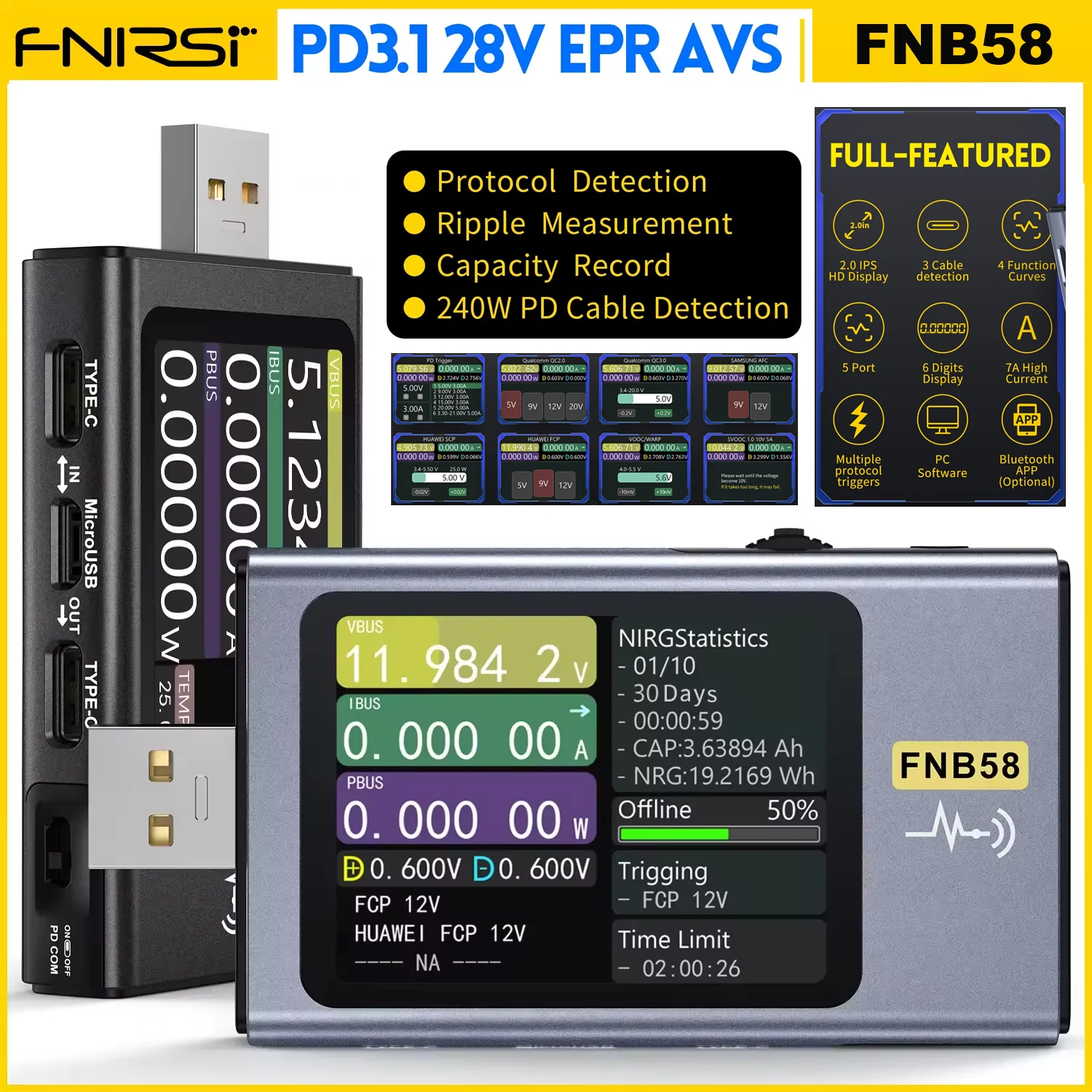
The FNB58 sits in line between a charger and a device and reports what is happening on the wire: voltage, current, power, accumulated capacity, cable resistance and ripple. Its more interesting function is protocol work. It carries a dedicated USB-PD negotiation chip and a physical switch deciding who negotiates — leave it off and the meter passively watches your phone and charger agree on a voltage; turn it on and the FNB58 becomes the negotiator, letting you demand 9 V, 20 V or a PPS voltage and see whether the charger delivers.
Gough Lui, who bench-tested one, found the accuracy respectable overall — helped by an external 16-bit ADC — with the caveat that raw high-rate sampling is noisy. Elektor's review reached a similar conclusion and singled out that PD switch as a real safety feature rather than a marketing bullet. Advertised protocol support runs to PD 2.0/3.0 and PPS, QC 2.0/3.0, FCP, SCP, AFC, VOOC and SuperVOOC, which is what makes it useful for working out why a particular phone charges slowly on a particular brick.
Who it's for — and who should skip it
Buy it if you own a drawer of USB-C cables of unknown provenance, repair phones, build power banks, or want to know which cable is throttling everything. Skip it if you have one laptop and one charger that already work — it will confirm that once and then live in a drawer. Skip it too if you need lab-grade numbers; this is a diagnostic tool, not a reference instrument.
The risks
Shipping: the listing we checked quoted six to eleven days from stock held near the buyer; orders shipping from China take considerably longer, and customs can add a week or more.
Warranty: FNIRSI does publish firmware updates, more than most marketplace brands manage, but there is no local RMA path. A dead unit is a dispute, not a repair.
Model confusion: the range includes the FNB48, FNB48P, FNB58, FNB-C2 and FNAC-28, and sellers mix the names freely in titles. Read the variant you are actually adding to the cart. Triggering high voltages also risks pushing 20 V into a device expecting 5 V — user error, but this tool makes it easy to commit.
The alternative
The ChargerLAB POWER-Z KM003C, listed at $109.99 by the manufacturer, is the reference tool in this category and the one charger reviewers use for published measurements. It offers deeper protocol decoding and a more trustworthy accuracy claim. If your income depends on the numbers, pay the difference. If you are hunting a bad cable, you do not need it.
What we don't know: we have not checked this unit's readings against a calibrated source, and cannot say how current firmware behaves with the newest PD 3.1 chargers.
Shipping is the first thing to get realistic about. Listings advertise best-case windows, usually based on stock already sitting in a warehouse near you. The ordinary experience for goods leaving China is closer to two to four weeks, and it stretches during Chinese New Year and peak sale events. If you need a tool for a job this weekend, this is not the channel. Customs is the second variable: depending on where you live a parcel may pass without charge, or you may be billed import tax plus a handling fee that is a meaningful fraction of a $30 item. Where a listing shows an estimated tax at checkout, treat it as an estimate rather than a quote.
Warranty is best understood as a fiction with one useful exception. There is no service centre and no engineer to call. What you do have is the platform's buyer protection window, and it works if you use it properly: photograph the parcel before opening it, film the unboxing when the item is fragile, and open a dispute inside the window instead of messaging the seller for a week first. Once the window closes, you own the problem.
Reading seller ratings takes care. A store rating above 95% is table stakes, not a distinction; more informative is units sold against number of reviews, the age of the store, and whether recent reviews carry buyer photographs of the actual item. Ignore the headline discount entirely — the crossed-out price is set by the seller. If something arrives broken, do not attempt a repair before opening the dispute, upload your photographs, and ask for a refund rather than a replacement, since a replacement restarts the shipping cycle. For related coverage, see our earlier round-ups on budget test gear under $30 and tools that do real work.
Our Read
Of the three, the FNB58 is the one we would buy first and argue for hardest. It does something no cheaper instrument does — lets you interrogate a USB-C negotiation rather than guess at it — and the branded alternative costs three times as much for capability most people never use. The TS101 is a qualified yes: excellent if you already own a good USB-C PD charger and buy from a seller with a long, photographed review history; a poor bet otherwise, because the counterfeit rate here is the highest of the three. The AN8008 is the one we would skip, and not because the measurements are bad — by independent accounts they are surprisingly good. We would skip it because a multimeter is the one tool here whose failure mode involves your hands and a live circuit, and a printed CAT III label on a $30 meter is a claim nobody has audited. Buy it for battery packs and Arduino rails, or buy a Fluke for anything else. There is no sensible middle.
What we still don't know: we have not handled these units. Tip-temperature accuracy, the actual input protection inside the meter, unit-to-unit consistency between sellers, and how any of the three survive a year of use are all questions only hands-on testing over time can answer.
Practical Tutorial — Thursday, September 17, 2026 The Permission You Forgot You Granted A 30-minute audit of every app still holding a key to your accounts GB GadgetGlow Bytes Editorial Published September 17, 2026 · 8 min read · How we work Changing your password does not log out the apps you connected to your account. Neither does turning on two-factor authentication. An OAuth grant — the thing that happens when you click "Continue with Google" or "Allow" on a permissions screen — issues a token that keeps working on its own schedule, independent of your password and usually independent of your second factor. Most people have granted dozens of them. Almost nobody has read the list back. This is a single-topic tutorial: find every third-party app holding access to your Google, Microsoft and Apple accounts, work out what each one can actually reach, and cut the ones that no longer earn their place. It takes about thirty minute...
Top 3 Best-Selling Mini PCs on AliExpress in 2025 – Which One Is Worth It? Hey everyone! In today’s post, we’re diving into the top 3 best-selling mini PCs on AliExpress up until June 2025. We'll take a close look at their advantages, disadvantages, performance, and even some of the funniest (and most helpful) customer reviews. If you’re looking for a compact, affordable, and surprisingly powerful mini computer, this post is for you. Let’s start with the first one on our list: the famous GMKtec G3 . According to AliExpress, this model has already sold over 10,000 units — and it’s not hard to see why. It comes with an Intel Alder Lake N100 processor , reaching up to 3.4 GHz, and is available with 8 GB or 16 GB of DDR4 RAM , and a 256 GB or 512 GB M.2 PCIe SSD , depending on the version you choose. Aliexpress Link: https://s.click.aliexpress.com/e/_oC43Wwa One standout feature is its two HDMI 2.0 ports , allowing you to connect dual 4K moni...
Best tablet controller for iPad Pro 13-inch, the Razer Kishi V3 Pro XL snaps onto larger tablets to deliver console-level comfort and precision for cloud gaming and native apps. Design & Compatibility Built from anodized aluminum and reinforced polymer, the Kishi V3 Pro XL stretches to fit iPad Pro and Air models up to 13” as well as Android tablets with USB-C from 10” to 13”. Its full-size thumbsticks feature drift-free TMR sensors, Hall Effect triggers ensure instant responsiveness, and a USB-C passthrough keeps you powered through marathon sessions. Two programmable rear macros round out the controls for custom loadout shortcuts. For IPAD: https://amzn.to/4kLrG9c For Iphone: https://amzn.to/4eaKYlS Evolving from the Smartphone Version Where the standard Razer Kishi V3 Pro handled screens up to 8”, the XL ups the ante with beefier grips, premium finishes and seamless support for full-size tablets without sacrificing haptic feedback on Android or PC remote-play...




Comments
Post a Comment