GadgetGlowBytes: Your go-to hub for in-depth gadget reviews, breaking tech news, and expert tips to supercharge your everyday tech experience.
A CO2 Meter, a Dust Sensor and a $5 Hygrometer: Three Air Monitors and the Spec That Decides Whether They Mean Anything
Get link
Facebook
X
Pinterest
Email
Other Apps
-
AliExpress Analysis
A CO₂ Meter, a Dust Sensor and a $5 Hygrometer: Three Air Monitors and the Spec That Decides Whether They Mean Anything
Air quality is the easiest thing in consumer electronics to fake, because almost nobody can check the answer.
GB
GadgetGlow Bytes Editorial
Published September 18, 2026 · 8 min read · How we work
Affiliate disclosure: this article contains affiliate links. If you buy through them we may earn a small commission at no extra cost to you. That does not change what we recommend — we have not physically tested these products, and everything below is based on published specifications, independent coverage and seller data, all sourced at the end. Prices were checked on September 18, 2026 and change frequently.
A thermometer is honest by construction. Put it in ice water and you will know within four minutes whether it is lying to you.
Air sensors are not like that. If a box on your shelf says the carbon dioxide in your bedroom is 780 ppm, you have no way of contradicting it. There is no household reference for CO₂, and none for particulate matter either. That is exactly why the category is full of devices that produce plausible numbers without measuring anything — and why the gap between a $13 detector and a $35 one is not polish, but whether a measurement happened at all.
The three below are a minimum useful set for knowing what is in the air at home: one instrument for ventilation, one for particles, one for the humidity that quietly corrupts both. We have not handled any of them. We have checked what sensing technology each claims, found independent work on that technology, and put the real limits next to the marketing.
What each one costs, and what you give up
Product
AliExpress price
Branded alternative
Shipping
Warranty
NDIR CO₂ meter with LCD, temp and humidity
~$34.92
Aranet4 Home, ~$189–200
15–40 days typical
Platform dispute window only; no local service
Nova Fitness SDS011 laser PM2.5 / PM10 module
~$22.71
PurpleAir Zen, $299
15–40 days typical
Bare component; effectively none
Tuya Wi-Fi / Zigbee temperature and humidity sensor
~$5.49 list
SensorPush HT1, $54.95
15–40 days typical
Replace rather than repair
Compiled by GadgetGlow Bytes. Prices verified September 18, 2026. Branded prices are US list prices at the manufacturer or a major retailer.
1. NDIR CO₂ Meter with Temperature and Humidity
Seller image, AliExpress
~$34.92 · checked September 18, 2026
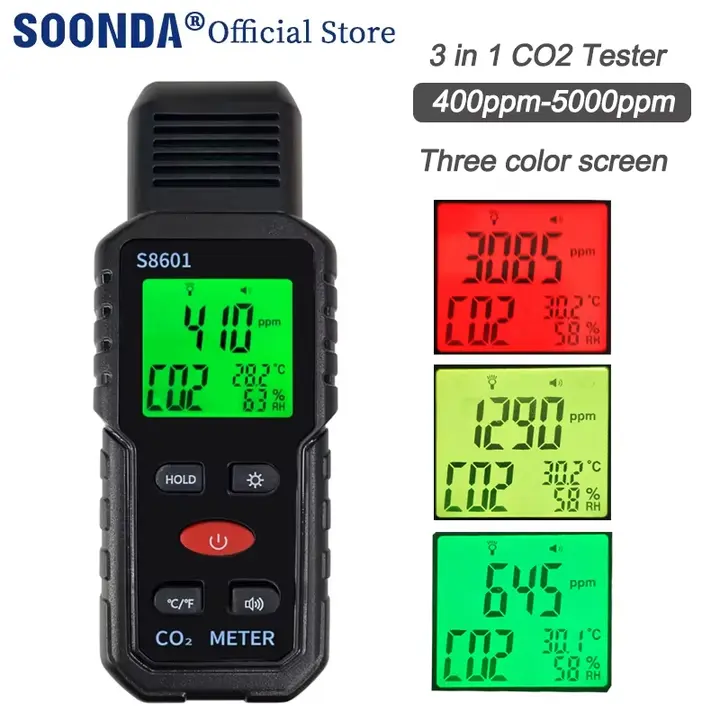
What it actually does. A desktop carbon dioxide meter with an LCD readout, an alarm threshold, and temperature and humidity on the same screen. The important word in the listing is NDIR — non-dispersive infrared. An NDIR cell shines infrared light through a chamber of room air and measures how much of one specific wavelength the CO₂ molecules absorb. It is a direct physical measurement of the gas you care about.
That matters because of the alternative. Many cheap "CO₂ detectors" contain a metal-oxide VOC sensor instead and report eCO₂ — a figure inferred from unrelated compounds. In one published comparison of the CCS811 against two real NDIR units, the NDIR sensors tracked each other closely overnight while the VOC-based unit sat flat and even rose during hours when CO₂ was demonstrably falling. Hackaday has torn down retail meters built this way. A $13 box claiming CO₂, formaldehyde, TVOC, PM2.5, PM10 and carbon monoxide at once is almost always one of them.
Who it's for — and who should skip it
For anyone who wants to know when to open a window. A bedroom that starts the night at 600 ppm and ends at 1,800 ppm is telling you something actionable. Skip it if you need defensible numbers for a workplace or a landlord dispute — and skip it if you hoped one box would measure formaldehyde, CO and particles too. It will print those numbers. It will not measure them.
Specifications, as published by the seller: NDIR infrared sensing, 400–5,000 ppm range, LCD with temperature and relative humidity, adjustable alarm, USB-C power. The listing carried 4.4 stars across roughly 96 recorded sales on September 18, 2026 — meaningful history, not conclusive.
The risks
Shipping: 15 to 40 days for a non-warehoused item, plus customs handling.
Warranty: the platform's dispute window and nothing else. No service centre, no manufacturer to call.
Counterfeits and substitution: the real hazard. Fake copies of the common MH-Z19B NDIR module circulate widely, nothing on the outside of a finished meter reveals what is inside, and sellers swap modules between production runs while the photos stay the same.
No calibration record: NDIR sensors drift, and cheap units rely on an automatic baseline that assumes the room periodically reaches outdoor CO₂ levels. In a room that never does, that baseline can be wrong for months.
The alternative
The Aranet4 Home, around $189 to $200, is the reference point: a documented NDIR sensor, a stated accuracy figure, e-ink display, battery life measured in years. Paying five times more is right when you need a number you can put in front of a school, an employer or a building manager. If the reading is only going to change your own behaviour, the $35 unit answers the same question.
What we don't know: we have not opened this unit or set it beside a reference instrument, so we cannot confirm which module is inside or how it drifts. If it arrives, the cheapest sanity check is to breathe on it from a few centimetres: a real NDIR cell climbs into the thousands within seconds and falls back over a minute or two. A VOC-based fake responds slowly, vaguely, or not at all.
2. Nova Fitness SDS011 Laser PM2.5 / PM10 Sensor Module
Seller image, AliExpress
~$22.71 · checked September 18, 2026
What it actually does. A laser scattering particle sensor: a small fan pulls room air past a laser, a photodiode measures the light scattered by whatever passes through, and firmware converts that into estimated PM2.5 and PM10 mass concentrations, sent out over a serial UART connection. It is a component, not a product. You supply the microcontroller and the power.
We are pointing at a bare module rather than a finished detector deliberately. The SDS011 is one of the few low-cost particle sensors with a real published literature behind it, because volunteer air-quality networks deployed it at scale and researchers then checked the results against regulatory reference stations. Its failure modes are documented rather than guessed at — more than any $13 handheld can say.
Who it's for — and who should skip it
For anyone comfortable wiring three pins to an ESP32 or a Raspberry Pi and running open firmware: logged, graphable particle data that means something, for the price of a takeaway meal. Skip it if you want a device with a screen that works out of the box, because this has neither. Skip it too if your main worry is wildfire smoke in a humid climate, where its weakest trait is most exposed.
Specifications, as published: 0.3 to 10 micrometre detection range, PM2.5 and PM10 outputs, UART at 9600 baud, 5 V supply, around 70 mA running. The useful numbers come from independent evaluation. Co-location studies report adequate correlation with reference instruments in typical conditions — roughly 20 to 50 percent relative humidity, moderate particle loads — and materially worse agreement outside that band. The sensor is specified only to 70 percent relative humidity, and in fog it substantially overstates concentration because it counts water droplets as particles. Broader work on this sensor class found high precision between units but accuracy against reference monitors ranging from about 13 percent to over 90 percent depending on conditions.
The risks
Shipping: 15 to 40 days. Small, light and cheap usually means the slowest tier by default.
Warranty: essentially none. If it is dead on arrival, return postage may exceed its value.
Seller variance and clones: SDS011 units are widely cloned and quality between sellers is uneven. Look for a listing that names Nova Fitness, and treat a price far below the going rate as a warning rather than a bargain.
Consumable by design: the fan and the optical chamber both foul. In dusty rooms, expect drift within a year or two and plan to replace rather than service it.
It does nothing alone: budget for a microcontroller, a supply and an evening of setup.
The alternative
The PurpleAir Zen at $299 is the finished-product answer: weather-resistant housing, dual sensors that cross-check each other, Wi-Fi, a maintained platform and a public map. Paying thirteen times more is right if the device is going outdoors, if you want data comparable with a network, or if the honest answer is that you will never get around to wiring the module up. A good sensor you never assemble is the most expensive option on this page.
What we don't know: we have not run this seller's module against a reference instrument, and cannot say whether this listing ships a genuine Nova Fitness part or a clone. The published research describes the sensor design, not this seller's stock.
3. Tuya Wi-Fi / Zigbee Temperature and Humidity Sensor
Seller image, AliExpress
~$5.49 list · checked September 18, 2026
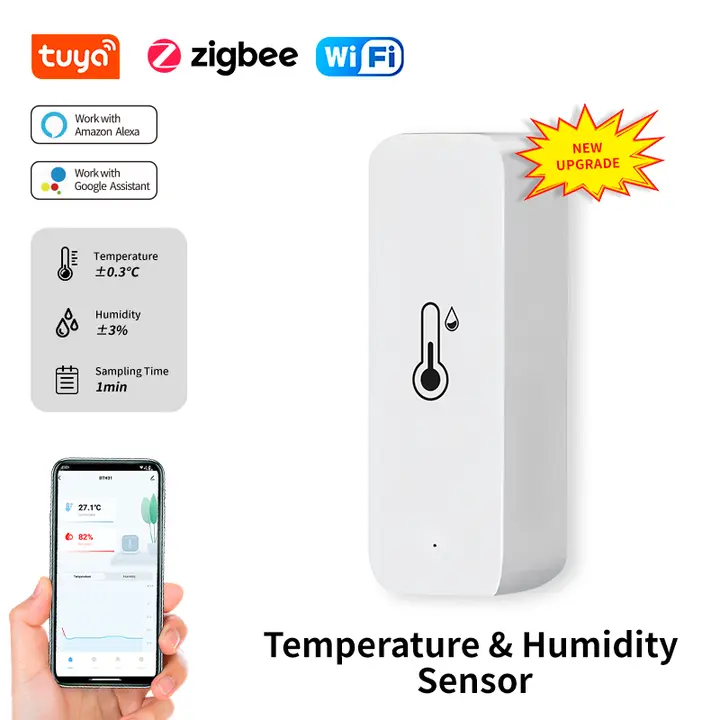
What it actually does. A battery-powered indoor sensor that reads temperature and relative humidity, shows them on a small screen, and reports to the Tuya and Smart Life apps over Wi-Fi or Zigbee, with Alexa and Google Assistant support. The variant matters: the Zigbee version needs a hub but lasts far longer on a battery; the Wi-Fi version needs no hub and drains cells much faster.
This is the least glamorous item here and the one we would buy first. Relative humidity is what makes the other two readings interpretable — it decides whether your particle sensor is counting dust or fog, and whether a room's condensation is a ventilation problem. Unlike CO₂ and particulates, it is cheap to measure honestly, because a competent digital humidity part costs a manufacturer well under a dollar. When this category goes wrong it is usually through bad placement, not fabricated data.
Who it's for — and who should skip it
For anyone who wants three or four rooms logged at once without spending $200. At this price you can instrument a whole flat and find the cold corner you never suspected. Skip it if you need certified accuracy, if you are protecting something where a two-degree error matters — a humidor, a server room, an instrument collection — or if you object to a cheap device routing traffic through a vendor cloud. If that last point bothers you, buy the Zigbee variant and pair it with a local hub.
Specifications, as published: indoor temperature and relative humidity with an LCD readout, Tuya and Smart Life app support, in-app history, automation triggers, and Wi-Fi or Zigbee depending on the variant. The listing carried 4.7 stars over 10,000-plus recorded sales on September 18, 2026 — by a wide margin the most established product here. The page also showed a $1.09 promotional price that applies only to first-time buyers; the list price of about $5.49 is what most readers will pay, and even that moves.
The risks
Shipping: 15 to 40 days, though high-volume listings more often ship from a regional warehouse and arrive at the fast end.
Warranty: nominal. At this price the device is a consumable, and nobody is repairing it — including the seller.
Quality variance: identical-looking Tuya devices come from many factories with different parts inside. Accuracy claims are rarely traceable to a datasheet, and two units from different sellers can disagree by more than either admits.
Cloud dependency: the Wi-Fi variant is useless if the vendor's service disappears or your account is locked. The Zigbee variant can be adopted by third-party local hubs — the safer long-term bet.
Promotional pricing: the headline figure is frequently first-order-only. Check it in your own cart before deciding it is a bargain.
The alternative
The SensorPush HT1 at $54.95 publishes what the cheap units do not: typical accuracy around 0.2 degrees Celsius and 2 percent relative humidity, on-device logging that survives an internet outage, multi-year battery life, no subscription. Paying ten times more is right exactly once — when a wrong reading costs you something. For a guitar collection, a wine store or a filament dry box, that is an easy trade. For finding out why the back bedroom feels clammy, it is not.
What we don't know: we have not measured this unit against a calibrated hygrometer, and cannot say which sensor part this seller fits. Nor can we verify the battery life claim, the specification most often overstated in this category.
Shipping is slower than the listing suggests. The checkout estimate is optimistic for anything not already in a regional warehouse; 15 to 40 days is the honest planning figure for small electronics. Items marked as shipping from a local warehouse really are faster, often under two weeks, and are usually worth a small premium.
Customs is your problem, not the seller's. Import rules differ everywhere and change often. A low-value parcel may pass untouched, may attract a flat import tax on the declared value including shipping, or may sit in a queue waiting for you to file something. Find out how your country treats sub-$50 imports before you order, not after.
Warranty is a word, not a service. What you have is the platform's buyer protection window and the seller's interest in their rating. That is often enough for a dead-on-arrival item and almost never enough for a failure in month eight. Nobody services a $23 sensor module. Price these as consumables.
Read the seller, not just the product. The useful signals are completed order count, listing age, and the three-star reviews — not the five-star ones, often incentivised, nor the one-star ones, usually about shipping. Buyer photographs are the most valuable thing on the page, because they show what actually arrives. If something turns up broken, photograph the parcel before opening it, open a dispute through the platform rather than negotiating in chat, and do it inside the protection window.
Our Read
If you buy one thing here, buy the $5 humidity sensor — probably three of them. It is the only item whose measurement is cheap to get right, it makes the other two interpretable, and at that price you cover a home rather than a room. The CO₂ meter is what we would buy second and scrutinise hardest on arrival: NDIR is the right technology and $35 is a fair price for it, but the counterfeit and quiet-substitution risk is real, and the whole value of the purchase rests on a component you cannot see. Do the breathe-on-it test the day it lands, while a dispute is still open to you. The SDS011 is the one we would tell most readers to skip — not because it is a bad sensor, it is the best-documented part in this article, but because it measures nothing until you build something around it, and it is weakest in exactly the humid conditions where people most want particle data. Buy it if you already own an ESP32 and would enjoy the evening. If that sentence made you tired, spend the money elsewhere.
What we still don't know: we have not handled any of these units. Everything that separates a good example from a bad one — which sensor is actually inside, how far it drifts in a year, whether the battery claim survives a winter, whether this seller's stock matches this seller's photos — can only be established by owning the thing and putting it next to a reference instrument. Treat this as a map of the risks, not a verdict on the hardware.
Top 3 Best-Selling Mini PCs on AliExpress in 2025 – Which One Is Worth It? Hey everyone! In today’s post, we’re diving into the top 3 best-selling mini PCs on AliExpress up until June 2025. We'll take a close look at their advantages, disadvantages, performance, and even some of the funniest (and most helpful) customer reviews. If you’re looking for a compact, affordable, and surprisingly powerful mini computer, this post is for you. Let’s start with the first one on our list: the famous GMKtec G3 . According to AliExpress, this model has already sold over 10,000 units — and it’s not hard to see why. It comes with an Intel Alder Lake N100 processor , reaching up to 3.4 GHz, and is available with 8 GB or 16 GB of DDR4 RAM , and a 256 GB or 512 GB M.2 PCIe SSD , depending on the version you choose. Aliexpress Link: https://s.click.aliexpress.com/e/_oC43Wwa One standout feature is its two HDMI 2.0 ports , allowing you to connect dual 4K moni...
Best tablet controller for iPad Pro 13-inch, the Razer Kishi V3 Pro XL snaps onto larger tablets to deliver console-level comfort and precision for cloud gaming and native apps. Design & Compatibility Built from anodized aluminum and reinforced polymer, the Kishi V3 Pro XL stretches to fit iPad Pro and Air models up to 13” as well as Android tablets with USB-C from 10” to 13”. Its full-size thumbsticks feature drift-free TMR sensors, Hall Effect triggers ensure instant responsiveness, and a USB-C passthrough keeps you powered through marathon sessions. Two programmable rear macros round out the controls for custom loadout shortcuts. For IPAD: https://amzn.to/4kLrG9c For Iphone: https://amzn.to/4eaKYlS Evolving from the Smartphone Version Where the standard Razer Kishi V3 Pro handled screens up to 8”, the XL ups the ante with beefier grips, premium finishes and seamless support for full-size tablets without sacrificing haptic feedback on Android or PC remote-play...
Introduction: Buckle Up, Buttercup – Tech is Sprinting! Technology isn't just advancing; it's absolutely sprinting! Every day, new innovations reshape how we live, work, and even dream. Forget yesterday's headlines; we're in a whirlwind of groundbreaking news that's shaping our present and designing our future. Ready to dive into the biggest tech stories that have everyone talking? 1. The AI Avalanche: Friend, Foe, or Future Boss? The Rise of the Machines (That Think!): AI isn't just for sci-fi anymore; it's the undisputed heavyweight champion of tech news, making waves everywhere. Generative AI: Creativity on Demand: Imagine an AI that creates stunning art, writes compelling stories, or even crafts complex code – all from a simple prompt. This is Generative AI, and it's already transforming creative industries, customer service, and software development, making innovation faster than ever. It's the reason your new marketing campaign feels almost...



Comments
Post a Comment