GadgetGlowBytes: Your go-to hub for in-depth gadget reviews, breaking tech news, and expert tips to supercharge your everyday tech experience.
A $12 Smart Plug, a $30 Clamp Meter and a $10 Panel Monitor: Three Ways to Find Out Where Your Electricity Goes
Get link
Facebook
X
Pinterest
Email
Other Apps
-
AliExpress Analysis
A $12 Smart Plug, a $30 Clamp Meter and a $10 Panel Monitor: Three Ways to Find Out Where Your Electricity Goes
One appliance, one wire, one whole house — and the certification question that decides which of these belongs near your mains.
GB
GadgetGlow Bytes Editorial
Published September 22, 2026 · 7 min read · How we work
Affiliate disclosure: this article contains affiliate links. If you buy through them we may earn a small commission at no extra cost to you. That does not change what we recommend — we have not physically tested these products, and everything below is based on published specifications, independent coverage and seller data, all sourced at the end. Prices were checked on September 22, 2026 and change frequently.
The cheapest way to cut a power bill is to find out what causes it
Electricity is the one household expense nobody gets itemised. You receive a single number each month, and when it climbs you are left guessing — which usually means economising on the wrong things, unplugging phone chargers that draw fractions of a watt while an ageing freezer burns hundreds of kilowatt-hours a year.
Measurement fixes that, and it has become cheap. The three products below form a ladder: a smart plug that reads one appliance, a clamp meter that reads any wire you can get a jaw around, and a current-transformer meter that reads the whole incoming supply. Each costs ten to thirty dollars, roughly a tenth of the branded equivalent.
That gap is not uniform. On one, the cheap version is a sensible buy. On another it is defensible with caveats. On the third, what you are saving on is the safety certification — the wrong corner to cut. Here is the reasoning, with what independent testers have measured.
How the three compare against their branded equivalents
Product
AliExpress price
Branded alternative
Shipping
Warranty
Tuya Zigbee 16A energy-monitoring plug
$12.48 list
Kasa EP25, approx. $8–12 per plug in a 4-pack
7–15 days on Choice listings
Platform dispute window only
UNI-T UT210E mini clamp meter
$29.69 entry variant
Fluke 323, $175.95
2–5 weeks standard
Return postage to China at your cost; Fluke ships with 2 years
80A Tuya bidirectional CT meter, DIN rail
$10.54
Emporia Vue 3, $99.99 mains-only / $149.99 with 8 sensors
2–5 weeks standard
None meaningful; fitting it may affect home insurance
Compiled by GadgetGlow Bytes. Prices verified September 22, 2026.
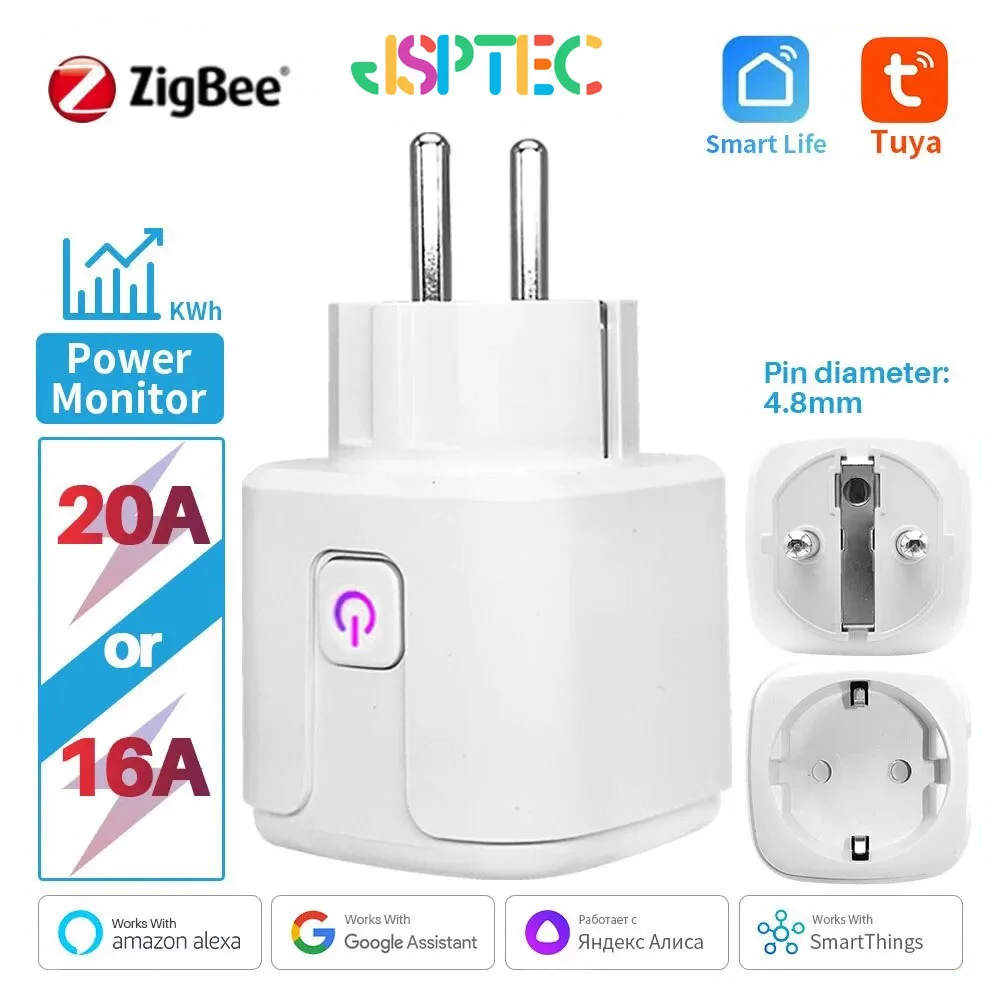
1. Tuya Zigbee 16A/20A Smart Plug with Energy Monitoring
Seller image, AliExpress
~$12.48 · checked September 22, 2026
The cheapest honest wattmeter you can buy. It sits between socket and appliance and reports instantaneous power, voltage, current and cumulative kilowatt-hours to a phone app, with daily and monthly history. Devices in this family are usually identified as the TS011F — they are how people discover their "idle" home office draws 90 watts around the clock.
The metering claim holds up better than the price suggests. Independent reviewers at SmartHomeScene found the energy measurement accurate, and the hardware is well supported in open-source home automation: Zigbee2MQTT carries pages for several TS011F variants, and Powercalc maintains a measured power profile. That is more third-party scrutiny than most $12 mains hardware ever receives.
Who it's for — and who should skip it
Right tool and right price for auditing appliances one at a time: buy two or three and rotate them around the house. Skip it if you do not run a Zigbee coordinator, and do not put one in front of anything whose uptime matters.
The risks
It may switch itself off. SmartHomeScene reproduced the fault reported by readers: the plug turned off at random roughly every two days. A curiosity on a lamp, a disaster on a freezer or router.
The firmware is a moving target. The same review documents a revision that disabled automatic reporting of power, current and voltage, forcing polling instead. You cannot tell which firmware you will receive, and Zigbee2MQTT discussions record variants misidentified as one another.
Seller variance, on a mains device. Identical bodies ship from dozens of shops using the same photos, and the "16A/20A" marking is an unverified claim about relay and contacts. The $1.09 shown when we checked is a "welcome deal" for brand-new accounts only; $12.48 is the real price.
The alternative
TP-Link's Kasa EP25 does the same job with Matter and HomeKit support, and four-packs have sold in the $31.99–$49.49 range — roughly $8–12 per plug, competitive once you buy more than one. Pay for the branded plug on any socket where an unexpected cut costs you something: freezer, router, sump pump, home server.
What we don't know: we have not handled this seller's unit, so we cannot say which firmware ships today or whether the shutdown fault persists in current production.
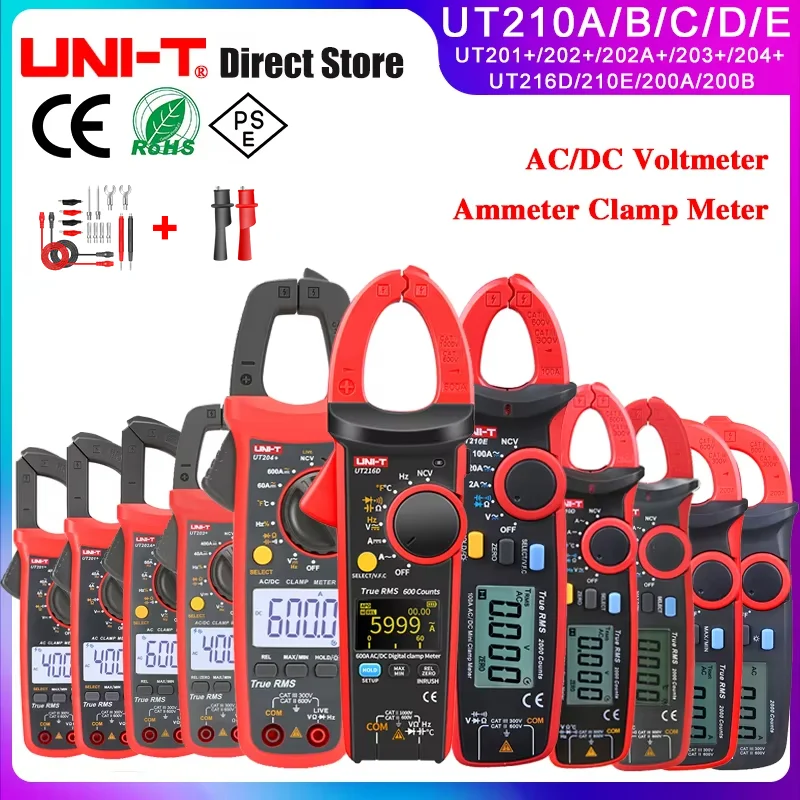
2. UNI-T UT210E Mini Clamp Meter
Seller image, AliExpress
~$29.69 · checked September 22, 2026
A clamp meter reads current without breaking the circuit — open the jaw, close it around one conductor, read. The UT210E is the small one hobbyists actually own, and its distinguishing feature is that the jaw reads DC as well as AC, making it useful for solar arrays, battery banks and car electrics rather than mains alone. It is a 2000-count meter with a quoted basic DC accuracy of 0.7%, and also handles voltage, resistance, continuity, capacitance and non-contact voltage detection.
It has been picked apart by independent testers for years, which is unusual at this price. Gough Lui found it met and exceeded its stated accuracy specifications, while noting that clamp jaws are not precision instruments — around 2% error at 0.5A and 5A. Mark Hennessy recorded 0.5% agreement with a Sanwa bench meter at 2A. HKJ's lygte-info test agrees broadly, and a long-running EEVblog thread documents EEPROM modifications that unlock a 6000-count display.
Who it's for — and who should skip it
Ideal for hobbyists, solar tinkerers and anyone chasing a parasitic drain, where DC current is the point and 2% is plenty. Skip it if you are a working electrician or intend to measure inside a distribution board — not for accuracy reasons, but because a budget meter's category rating is a printed claim, and that rating is what protects you when a measurement goes wrong.
The risks
The listing is not one product. Most bundle the UT210A, B, C, D and UT204+ behind a single price, and the headline figure is usually the cheapest variant. Only the E reads DC current — check the variant selector before paying.
Safety ratings here are unverified. The CAT markings and CE logo on a $30 clamp meter are a manufacturer's assertion. Treat them as marketing, not as something to stand behind on live mains.
Counterfeits exist; no calibration certificate. UNI-T is a real brand, which makes it worth faking — buy from a store identifying as a UNI-T factory or instrument store with substantial order history.
The alternative
The Fluke 323 lists at $175.95 — six times the price, and it does less, reading AC current only. The money buys a certified safety category, a two-year warranty and a meter that still reads correctly in a decade. If you are paid to work on someone else's installation, that is the cost of the job. For your own amplifier's standby draw, it is overkill.
What we don't know: we have not handled a unit from this seller, the reviews cited tested meters bought years ago, and we have not verified any safety-category claim ourselves.
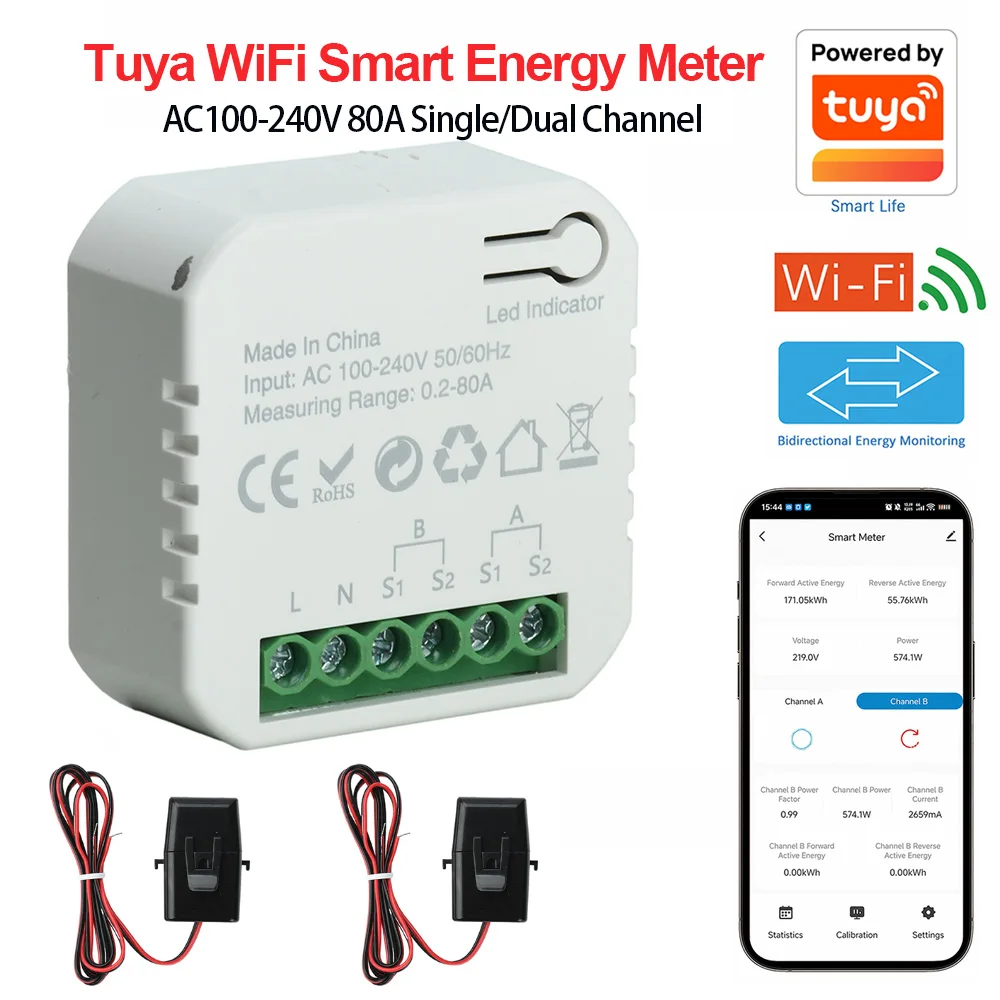
3. 80A Tuya Bidirectional CT Clamp Energy Meter, DIN Rail
Seller image, AliExpress
~$10.54 · checked September 22, 2026
The whole-house rung of the ladder. A split-core current transformer clips around the incoming live conductor with nothing cut, and a DIN-rail module reads it and reports over Wi-Fi. The bidirectional part matters if you have solar: it separates import from export, so you see generation and self-consumption instead of one confusing net figure.
The category works and integrates properly. SmartHomeScene's review of a Tuya clamp energy meter confirms it pulls into Home Assistant via Zigbee2MQTT or ZHA, with voltage, current, power and energy all calibratable in software — which is how you correct a cheap CT against a reference. They measured temperature drift under 3% across a 12°C to 32°C swing over 24 hours. The Home Assistant community maintains long threads on the single- and three-phase variants.
Who it's for — and who should skip it
For people with solar, a home automation setup they trust, and an electrician they can call. It is the only one here giving a continuous whole-property baseline — and emphatically not for most readers, because it installs inside your consumer unit, which is licensed work in most jurisdictions. If your reaction to "mount this next to your main breaker" is to reach for a screwdriver, skip it. Renters should skip it outright.
The risks
It goes inside your breaker panel. The CT clips on without cutting anything, but the module still needs live and neutral from inside the enclosure. Not a DIY job, not legal for a homeowner in many places, and an unlisted device wired into a distribution board is what an insurer points at after a fire.
The certification is thin. CE and similar marks here are frequently self-declared. Coverage of these meters notes they lack the Class 0.5 accuracy certification required for revenue-grade metering — treat the numbers as indicative, not billable.
Cloud dependence and seller variance. Most buffer nothing locally, so a Wi-Fi outage is a hole in your data. This listing also had only 47 sales when we checked — thin evidence for something left energised in a metal enclosure for a decade.
The alternative
The Emporia Vue 3 starts at $99.99 for whole-home mains monitoring, $149.99 with eight circuit sensors and $199.99 with sixteen, quotes ±2% accuracy and charges no subscription. Its relevance just grew: Sense stopped selling its monitor on December 31, 2025, leaving Emporia as the main circuit-level option. Ten times the price buys a listed product and a company to complain to — and in a panel, where the failure modes are fire and a voided policy, that is where to spend.
What we don't know: we have not opened one, so we can say nothing about the isolation between its mains and low-voltage sides — the question that decides whether it belongs in a consumer unit.
Buying from AliExpress: what to expect
Shipping and customs. Choice listings move fastest — the plug above quoted about a week to ten days when we checked. Everything else varies, and two to five weeks is normal. Low-value import thresholds have been tightening in most markets, so a parcel that arrived untaxed two years ago may now attract duty and a handling fee, which matters on a $10 purchase.
Warranty, realistically. There is none in the sense you are used to — only a platform dispute window that opens on delivery and closes a couple of weeks later. Inside it the process works: open a dispute with photographs and you will usually get a refund. Outside it, a $12 plug that dies is gone, and posting a $30 meter back to China costs more than the meter.
Ratings, and what to do when it arrives broken. Store rating matters more than product rating, and order count more than both: 1,000+ sales at 4.8 beats a 5.0 with nine orders, because the 5.0 is noise. Filter reviews to those with photos. If it arrives damaged, photograph the packaging before opening, and open a platform dispute rather than messaging the seller — the clock is running, and private negotiation does not pause it. Never energise mains hardware that arrived visibly damaged.
Our Read
The clamp meter is the one we would buy. It is self-contained — no firmware to regress, no cloud, no installation to get wrong — and several independent testers have measured it and found it honest about its own accuracy. At a sixth of the Fluke price, for hobby-level work, it is the clearest value here, provided you select the E variant deliberately and never take it near a distribution board. The smart plug is a qualified yes: excellent as a diagnostic you move around the house, poor as a switch you depend on, and the documented random-shutdown behaviour is why we would not put one in front of a freezer. The CT meter we would skip — not because it fails to work, but because the money saved is the money that would otherwise buy an independently tested product for permanent installation inside your electrical panel, the worst place in a house to economise. If the goal is simply finding out where your electricity goes, two smart plugs and a weekend get most of the answer for $25.
What we still don't know: we have not handled these units, so the above is inference from specifications and other people's measurements. Hands-on use would settle what actually decides these purchases: whether this batch of plugs still shows the shutdown fault, and how the clamp meter holds its zero after a year in a toolbox.
Top 3 Best-Selling Mini PCs on AliExpress in 2025 – Which One Is Worth It? Hey everyone! In today’s post, we’re diving into the top 3 best-selling mini PCs on AliExpress up until June 2025. We'll take a close look at their advantages, disadvantages, performance, and even some of the funniest (and most helpful) customer reviews. If you’re looking for a compact, affordable, and surprisingly powerful mini computer, this post is for you. Let’s start with the first one on our list: the famous GMKtec G3 . According to AliExpress, this model has already sold over 10,000 units — and it’s not hard to see why. It comes with an Intel Alder Lake N100 processor , reaching up to 3.4 GHz, and is available with 8 GB or 16 GB of DDR4 RAM , and a 256 GB or 512 GB M.2 PCIe SSD , depending on the version you choose. Aliexpress Link: https://s.click.aliexpress.com/e/_oC43Wwa One standout feature is its two HDMI 2.0 ports , allowing you to connect dual 4K moni...
Best tablet controller for iPad Pro 13-inch, the Razer Kishi V3 Pro XL snaps onto larger tablets to deliver console-level comfort and precision for cloud gaming and native apps. Design & Compatibility Built from anodized aluminum and reinforced polymer, the Kishi V3 Pro XL stretches to fit iPad Pro and Air models up to 13” as well as Android tablets with USB-C from 10” to 13”. Its full-size thumbsticks feature drift-free TMR sensors, Hall Effect triggers ensure instant responsiveness, and a USB-C passthrough keeps you powered through marathon sessions. Two programmable rear macros round out the controls for custom loadout shortcuts. For IPAD: https://amzn.to/4kLrG9c For Iphone: https://amzn.to/4eaKYlS Evolving from the Smartphone Version Where the standard Razer Kishi V3 Pro handled screens up to 8”, the XL ups the ante with beefier grips, premium finishes and seamless support for full-size tablets without sacrificing haptic feedback on Android or PC remote-play...
Introduction: Buckle Up, Buttercup – Tech is Sprinting! Technology isn't just advancing; it's absolutely sprinting! Every day, new innovations reshape how we live, work, and even dream. Forget yesterday's headlines; we're in a whirlwind of groundbreaking news that's shaping our present and designing our future. Ready to dive into the biggest tech stories that have everyone talking? 1. The AI Avalanche: Friend, Foe, or Future Boss? The Rise of the Machines (That Think!): AI isn't just for sci-fi anymore; it's the undisputed heavyweight champion of tech news, making waves everywhere. Generative AI: Creativity on Demand: Imagine an AI that creates stunning art, writes compelling stories, or even crafts complex code – all from a simple prompt. This is Generative AI, and it's already transforming creative industries, customer service, and software development, making innovation faster than ever. It's the reason your new marketing campaign feels almost...


Comments
Post a Comment