GadgetGlowBytes: Your go-to hub for in-depth gadget reviews, breaking tech news, and expert tips to supercharge your everyday tech experience.
Fold Wars 2026: Apple, Samsung, Xiaomi and Google All Bet on the Same Shape
Get link
Facebook
X
Pinterest
Email
Other Apps
-
GADGET FEATURE — SEPTEMBER 23, 2026
Fold Wars 2026: Apple, Samsung, Xiaomi and Google All Bet on the Same Shape
Four foldables landed within six weeks of each other. Here's how they actually compare.
GB
GadgetGlow Bytes Editorial
Published September 23, 2026 · 9 min read · How we work
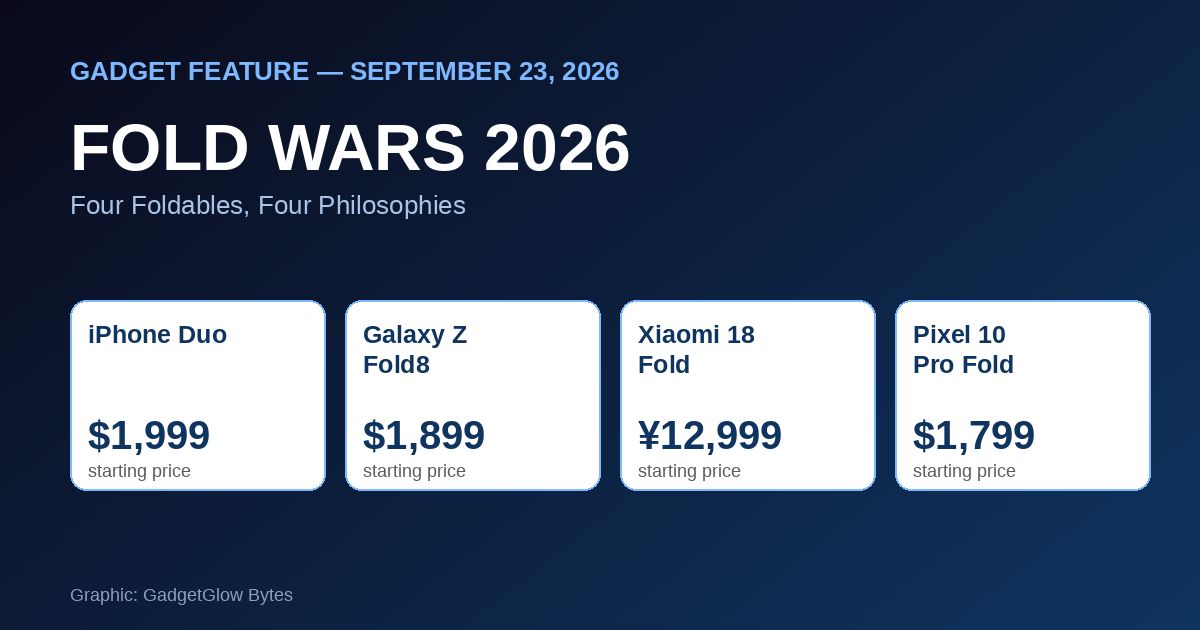
The four wide-format foldables now shipping or announced as of late September 2026. Graphic: GadgetGlow Bytes
In the span of about six weeks — from Samsung's Unpacked event on July 22 to Xiaomi's Beijing launch on September 7 — four of the industry's biggest phone makers each shipped or announced a book-style foldable built around a roughly 7.6- to 8-inch inner display. Apple's iPhone Duo, Samsung's Galaxy Z Fold8 and Fold8 Ultra, Xiaomi's 18 Fold, and Google's Pixel 10 Pro Fold now sit on the same shelf, at prices ranging from $1,799 to just over $3,000. They are not interchangeable. Each company made a different bet about what a folding phone is actually for, and those bets show up in the spec sheet as much as in the marketing copy. Below is what each device actually offers, who it fits, and what it costs as of this week.
01
iPhone Duo — Apple's First Foldable, Priced Like It
Key takeaway: The thinnest, most expensive of the four, aimed squarely at existing iPhone Pro owners rather than Android switchers.
Apple unveiled the iPhone Duo on September 9, 2026, calling it "the biggest change to iPhone" since the original. Opened, it carries a 7.6-inch inner display with a nano-texture finish designed to cut glare; closed, the 5.4-inch outer screen gives roughly 90 percent of the screen area of the iPhone 18 Pro in a pocketable shell that Apple says is the thinnest iPhone it has built. It runs the same A20 Pro chip (built on a 2-nanometer process) as the iPhone 18 Pro and Pro Max, and hides its FaceTime camera under the inner display rather than using a notch or punch-hole.
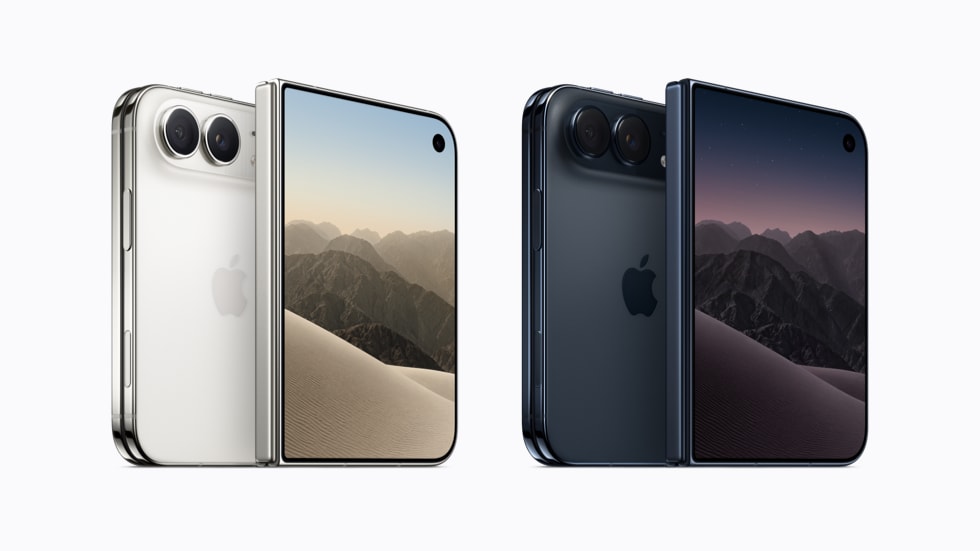
iPhone Duo in dark blue and white. Image: Apple Newsroom
Pricing starts at $1,999 for 256GB and climbs to $3,199 for the 2TB model — a spread that makes the Duo the most expensive phone Apple sells outright. Preorders open October 16, with shipping starting October 23 in roughly 70 countries and regions.
Buy it if: you're already inside Apple's ecosystem, want the thinnest hardware of the group, and don't mind paying a premium for a first-generation product. Skip it if: storage matters more than thinness — the jump to 2TB adds $1,200 — or you want a proven multi-generation hinge; Apple has no folding-phone track record to point to yet. The obvious cheaper alternative inside Apple's own lineup is the iPhone 18 Pro Max, which starts hundreds of dollars lower and carries the same chip in a conventional slab body.
02
Galaxy Z Fold8 & Fold8 Ultra — Samsung's Seventh-Generation Refinement
Key takeaway: The most mature hardware here — seven generations of hinge work — split into a lighter mainstream model and a heavier-spec Ultra.
Samsung unveiled the Galaxy Z Fold8 lineup at Unpacked on July 22 and shipped it August 7. The standard Fold8 weighs 201 grams — Samsung's lightest Fold yet — and pairs a Snapdragon 8 Elite Gen 5 chip with a 4,800 mAh battery and dual 50 MP rear cameras. The Fold8 Ultra pushes further: an 8.0-inch main display, a 5,000 mAh battery, a 200 MP main camera with a new 50 MP ultra-wide, and a body just 4.1mm thick when unfolded at 215 grams. Both use Samsung's new Flex Titanium display structure, which the company says reduces crease visibility and lets the hinge fold more smoothly.
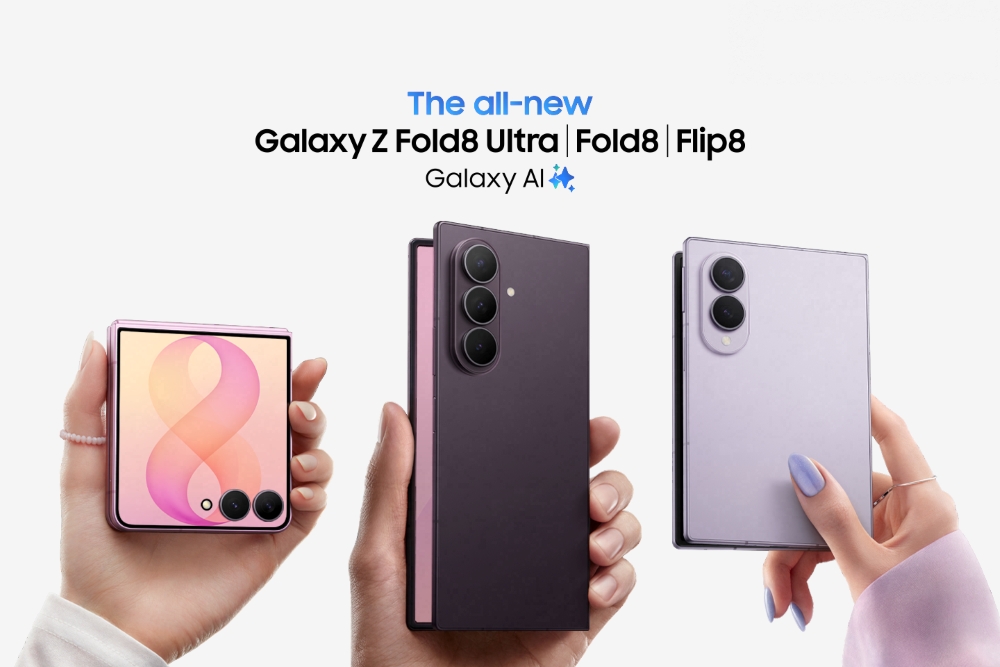
Galaxy Z Fold8 Ultra, Fold8 and Flip8 at Galaxy Unpacked. Image: Samsung Newsroom
The Fold8 starts at $1,899; Samsung has not published a separate Ultra starting price in the source material reviewed for this piece, and buyers should confirm the Ultra's price directly with Samsung or a carrier before ordering.
Buy it if: you want the most battle-tested hinge mechanism of the four and prefer Samsung's wider Android customization. Skip it if: you want Samsung's absolute best camera and don't mind paying more — that's what the Ultra tier exists for, and the standard Fold8's dual-camera setup (no telephoto) is a real step down from the Ultra's triple system. A cheaper alternative in Samsung's own family worth considering is the Galaxy Z Flip8, a clamshell rather than a book-fold, which starts well under $1,899.
03
Xiaomi 18 Fold — The Spec-Sheet Winner Most Readers Can't Buy
Key takeaway: On paper the strongest battery, brightness and charging speed of the group — but it's a China-only launch with no confirmed international release.
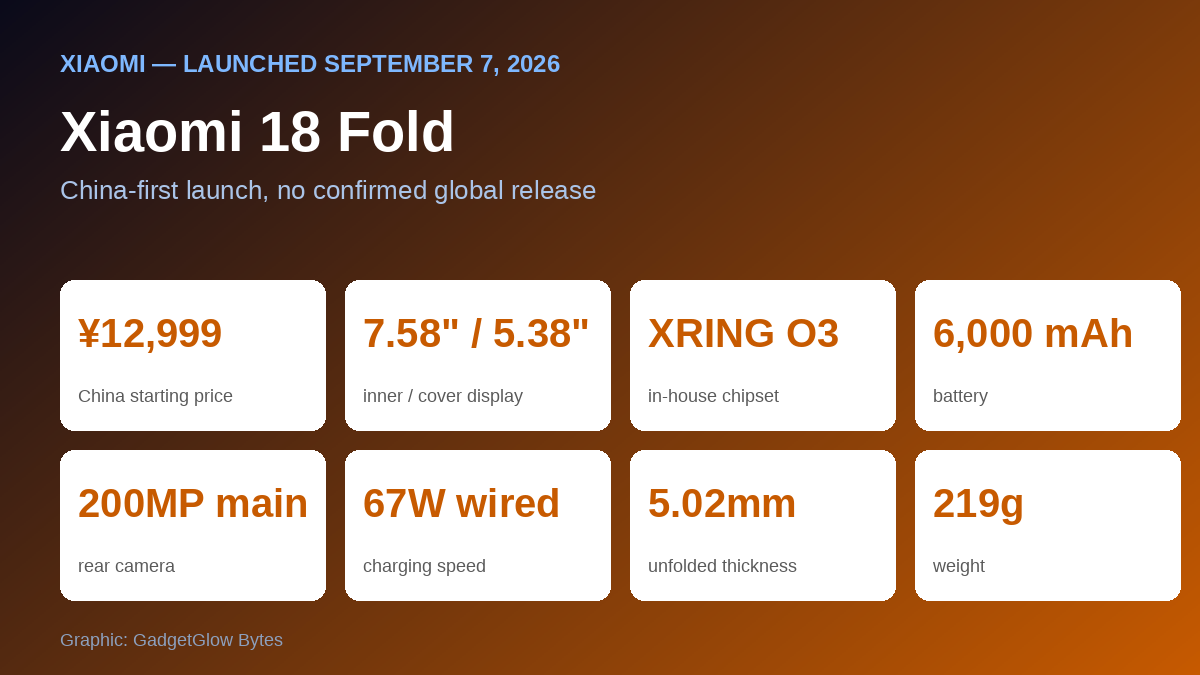
Xiaomi unveiled the 18 Fold in Beijing on September 7 and began retail sales in China three days later. It pairs a 7.58-inch inner display and 5.38-inch cover display — both AMOLED, both rated to 4,000 nits peak brightness — with Xiaomi's own in-house XRING O3 chip, built on a 3nm process. The 6,000 mAh battery is the largest of the four phones here, and its 67W wired / 50W wireless charging is also the fastest. The triple rear camera is led by a 200 MP main sensor. Unfolded, it's just 5.02mm thick and weighs 219 grams.
Xiaomi has not announced international pricing or a launch date outside China. Graphic: GadgetGlow Bytes, compiled from Xiaomi's September 7 launch specifications.
Pricing starts at CNY 12,999 (about $1,937 at prevailing exchange rates) for the 12GB/256GB configuration in China. As of this writing, Xiaomi has not announced international pricing, availability, or a launch window for any market outside China, including the U.S. and EU.
Buy it if: you're purchasing in China or are comfortable importing and dealing with software localization. Skip it if: you need a device with official carrier support, warranty coverage, or Google Mobile Services outside China — none of which Xiaomi has confirmed for this model. There is no direct cheaper alternative to recommend here since the phone itself isn't sold internationally; readers outside China chasing similar specs should look at the Fold8 or Pixel 10 Pro Fold instead.
04
Pixel 10 Pro Fold — The Cheapest of the Four, and the Most AI-Forward
Key takeaway: The budget option of this group by a wide margin, leaning on Gemini-powered software rather than headline hardware specs.
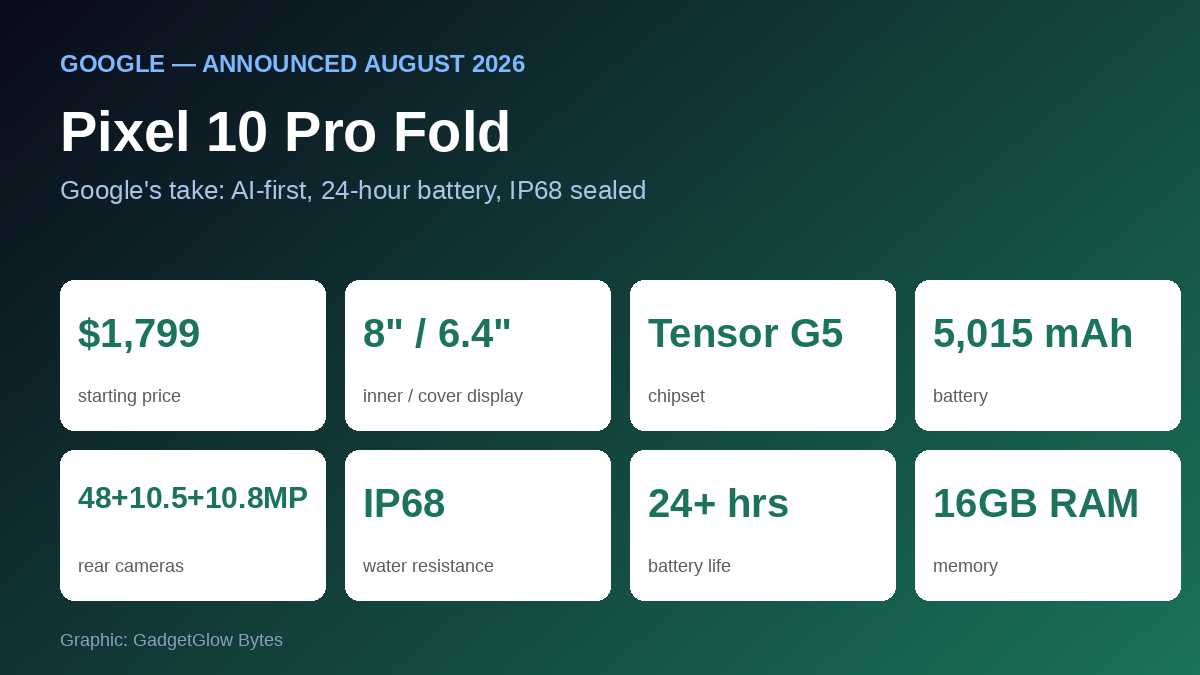
Google's Pixel 10 Pro Fold pairs an 8-inch Super Actua Flex inner display with a 6.4-inch Actua cover screen, both running at 120Hz, wrapped around the Tensor G5 chip — Google's own listing describes it as a 34 percent CPU gain and up to 60 percent more powerful TPU over the previous Tensor G4. It's the first Pixel Fold with IP68 dust and water resistance and Corning Gorilla Glass Victus 2 on the cover screen. The triple rear camera (48 MP wide, 10.5 MP ultrawide, 10.8 MP telephoto with 5x optical zoom) is a step down from Samsung's and Xiaomi's 200 MP main sensors on paper, and the 5,015 mAh battery is the smallest of the four — though Google rates it for 24-plus hours with the same 30W wired charging speed carried over from prior generations.
Specifications compiled by GadgetGlow Bytes from Google's official product page. Graphic: GadgetGlow Bytes
It starts at $1,799 for the 16GB/256GB configuration — $100 to $200 less than every other phone in this comparison — with financing available at roughly $50/month over 36 months through the Google Store.
Buy it if: price matters, you're already a Gemini/Google user, or you want the only foldable here with an official IP68 water-resistance rating. Skip it if: camera resolution and zoom range are the priority — the 10.8 MP telephoto tops out well short of what Samsung's Ultra tier offers. The obvious cheaper alternative, if even $1,799 is too much, is last year's Pixel 9 Pro Fold, which Google continues to sell at a discount while supplies last.
Side by Side
Model
Starting price
Inner / cover display
Chipset
Battery
Main camera
iPhone Duo
$1,999
7.6" / 5.4"
Apple A20 Pro
Not disclosed
48MP Fusion
Galaxy Z Fold8
$1,899
7.6" / 5.5"
Snapdragon 8 Elite Gen 5
4,800 mAh
50MP dual
Galaxy Z Fold8 Ultra
Not disclosed*
8.0" / 6.5"
Snapdragon 8 Elite Gen 5
5,000 mAh
200MP triple
Xiaomi 18 Fold
¥12,999 (China only)
7.58" / 5.38"
XRING O3
6,000 mAh
200MP triple
Pixel 10 Pro Fold
$1,799
8.0" / 6.4"
Google Tensor G5
5,015 mAh
48MP triple
*Samsung has not published a separate Fold8 Ultra starting price in the sources reviewed for this piece; confirm current pricing with Samsung or your carrier before ordering. Specifications compiled by GadgetGlow Bytes from manufacturer sources, verified September 23, 2026.
Our Read
What's notable isn't any single spec — it's that four companies with almost no coordination converged on the same physical answer this cycle: a roughly 5.4-to-6.5-inch cover screen wrapped around a 7.6-to-8-inch inner display, in a book-fold form factor, all within seven weeks of each other. That convergence suggests the industry has settled on wide-format book folds as the foldable form factor worth investing in, at least for this generation — the smaller "flip" clamshell category (Flip8, Razr, etc.) is increasingly treated as a separate, cheaper product line rather than a stepping stone. For buyers, that means the real differentiation left is software and camera philosophy, not screen size: Apple is selling ecosystem lock-in and thinness, Samsung is selling maturity and camera range, Xiaomi is selling raw spec-sheet numbers it can't yet sell to most of the world, and Google is selling AI features at the lowest price of the four.
What we still don't know: none of these four devices has been in consumer hands long enough for independent durability testing — hinge wear, crease depth after months of folding, and battery degradation are all unverified claims from the manufacturers at this point. Samsung also has not published a standalone Fold8 Ultra price in the material available as of this writing, which makes a true four-way price comparison incomplete until that number is public.
Prices and specifications verified September 23, 2026 and subject to change. GadgetGlow Bytes does not receive products from manufacturers for coverage.
Top 3 Best-Selling Mini PCs on AliExpress in 2025 – Which One Is Worth It? Hey everyone! In today’s post, we’re diving into the top 3 best-selling mini PCs on AliExpress up until June 2025. We'll take a close look at their advantages, disadvantages, performance, and even some of the funniest (and most helpful) customer reviews. If you’re looking for a compact, affordable, and surprisingly powerful mini computer, this post is for you. Let’s start with the first one on our list: the famous GMKtec G3 . According to AliExpress, this model has already sold over 10,000 units — and it’s not hard to see why. It comes with an Intel Alder Lake N100 processor , reaching up to 3.4 GHz, and is available with 8 GB or 16 GB of DDR4 RAM , and a 256 GB or 512 GB M.2 PCIe SSD , depending on the version you choose. Aliexpress Link: https://s.click.aliexpress.com/e/_oC43Wwa One standout feature is its two HDMI 2.0 ports , allowing you to connect dual 4K moni...
Best tablet controller for iPad Pro 13-inch, the Razer Kishi V3 Pro XL snaps onto larger tablets to deliver console-level comfort and precision for cloud gaming and native apps. Design & Compatibility Built from anodized aluminum and reinforced polymer, the Kishi V3 Pro XL stretches to fit iPad Pro and Air models up to 13” as well as Android tablets with USB-C from 10” to 13”. Its full-size thumbsticks feature drift-free TMR sensors, Hall Effect triggers ensure instant responsiveness, and a USB-C passthrough keeps you powered through marathon sessions. Two programmable rear macros round out the controls for custom loadout shortcuts. For IPAD: https://amzn.to/4kLrG9c For Iphone: https://amzn.to/4eaKYlS Evolving from the Smartphone Version Where the standard Razer Kishi V3 Pro handled screens up to 8”, the XL ups the ante with beefier grips, premium finishes and seamless support for full-size tablets without sacrificing haptic feedback on Android or PC remote-play...
Introduction: Buckle Up, Buttercup – Tech is Sprinting! Technology isn't just advancing; it's absolutely sprinting! Every day, new innovations reshape how we live, work, and even dream. Forget yesterday's headlines; we're in a whirlwind of groundbreaking news that's shaping our present and designing our future. Ready to dive into the biggest tech stories that have everyone talking? 1. The AI Avalanche: Friend, Foe, or Future Boss? The Rise of the Machines (That Think!): AI isn't just for sci-fi anymore; it's the undisputed heavyweight champion of tech news, making waves everywhere. Generative AI: Creativity on Demand: Imagine an AI that creates stunning art, writes compelling stories, or even crafts complex code – all from a simple prompt. This is Generative AI, and it's already transforming creative industries, customer service, and software development, making innovation faster than ever. It's the reason your new marketing campaign feels almost...


Comments
Post a Comment