The 1,600-Year-Old Iron Column That Modern Engineering Still Can't Fully Replicate
- Get link
- X
- Other Apps
The 1,600-Year-Old Iron Column That Modern Engineering Still Can't Fully Replicate
🗼 The Monument That Refuses to Rust
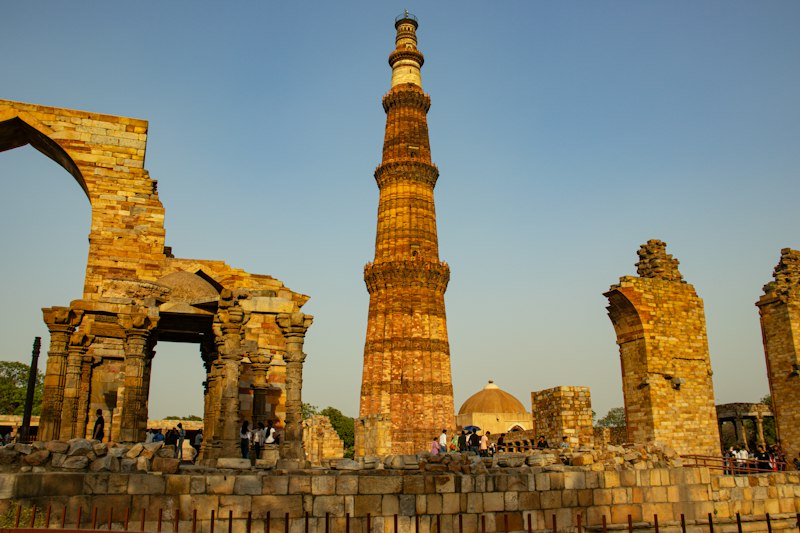
In the courtyard of the Qutb complex in Mehrauli, Delhi, stands a 23.5-foot column of solid wrought iron, weighing roughly six tonnes, that has been exposed to open air, monsoon rain, and city pollution for more than a millennium and a half — and has never developed a flaking, structurally compromising layer of rust. Metallurgists date its forging to around 400 CE, during the Gupta dynasty, and a Sanskrit inscription on its surface credits a king named Chandra, widely believed to be Chandragupta II, with commissioning it, likely as a flagstaff for a Vishnu temple that may originally have stood in Udayagiri, more than 600 miles away.
How and when it reached Delhi is still debated. One account holds that the sultan Iltutmish had it transported in the 13th century; another traces its more local journey from a temple at Lal Kot, moved by the Tomara king Anangapala around 1050 and repositioned near the Qūwat-ul-Islām mosque roughly a century later. What isn't in dispute is the pillar's remarkable physical record: a cannonball fired at close range during a later period left a visible dent and internal fissuring, yet the column held its shape, and to this day it shows no meaningful corrosion — a property that western metallurgists only began to seriously investigate in the 20th century, some 1,500 years after it was cast.
⚗️ The Chemistry Behind the "Miracle"

Researchers who have studied cross-sections of the pillar's surface — most notably a team at the Indian Institute of Technology Kanpur — found that ancient smiths, working without any concept of modern chemistry, produced wrought iron with an unusually high phosphorus content of roughly one percent, and almost no sulfur or manganese, the elements that typically accelerate corrosion in iron. That phosphorus, combined with slag and unreduced iron oxide particles trapped in the metal's microstructure, set off a slow three-stage chemical reaction once the pillar was exposed to the elements.
Over decades of alternating wet and dry seasons, the phosphorus catalyzed the formation of a compact, amorphous layer of iron oxide-hydroxide directly against the metal surface. Cycles of monsoon humidity and dry heat then gradually converted that layer into a crystalline compound called iron hydrogen phosphate hydrate — effectively a self-forming, self-healing ceramic-like shield that has stopped oxygen and moisture from ever reaching the iron beneath. Modern steel, by contrast, is deliberately purified of phosphorus because in the wrong proportions it makes iron brittle — a tradeoff Gupta-era smiths apparently balanced by accident, or by an empirical craft knowledge whose full recipe was never written down.
🔬 What Modern Engineers Are Still Learning
The pillar's passive-film chemistry has become a genuine reference point in corrosion science. Papers on the subject — including a well-cited analysis published in the journal Corrosion Science — argue that the same phosphate-based passivation mechanism could inform coatings for infrastructure that must survive decades without maintenance: bridge supports, pipelines, and offshore structures where replacing a protective layer is expensive or physically difficult. Sodium-ion battery research and other current materials-science efforts around cheaper, longer-lasting metals echo the same basic goal the Gupta smiths solved by trial and error: durability without constant intervention.
There is also a quieter lesson here about how "ancient" and "advanced" get defined. The pillar isn't magical — its resistance follows ordinary electrochemistry — but it required precise, repeatable control over ore composition and smithing technique at a scale (a single forged 6-tonne piece, not welded from many small parts, was itself a major feat for the year 400) that historians still find impressive. Nearly a millennium and a half later, the column is a working demonstration that the boundary between "craft" and "engineering" has always been blurrier than it looks.
"The formation of the protective passive film has been essentially due to the presence of second phase particles enriched in phosphorus, which is the basis of the excellent corrosion resistance shown by this ancient iron." — Balasubramaniam & Kumar, Corrosion Science, IIT Kanpur study
Sources
- Wikipedia — Iron pillar of Delhi
- IIT Kanpur (Balasubramaniam & Kumar) — On the corrosion resistance of the Delhi iron pillar
- CNN Travel — Why New Delhi's Iron Pillar has never shown signs of rust
- PMC / National Institutes of Health — Uncovering the superior corrosion resistance of iron made via ancient Indian iron-making practice
- Encyclopaedia Britannica — Iron Pillar of Delhi
- Get link
- X
- Other Apps


Comments
Post a Comment